Locking D Ring Shackle: 3 Best Picks for Off-Road Recovery (2026)
Compare 3 locking D ring shackles for off-road recovery. See sizing, working load limits, pin design and key features to pick the right one for your rig.
 By Graham Fisher
Updated November 8, 2026
 By Graham Fisher
Updated November 2026
Shoppers looking for a locking D ring shackle usually want one thing: a secure connection between a recovery strap or winch line and a vehicle’s mounting point that won’t work loose or come off on the trail. This guide compares three real, widely sold options by looking at published specifications, brand reputation and the patterns owners tend to report. We focused on working load limit (WLL), break strength, pin diameter, finish and how well each one suits common off-road recovery tasks.
Our top picks at a glance
- 1TOP CHOICEBest overallD Ring Shackles 3/4" Heavy Duty 4.75 Ton Screw Pin Anchor ShacklesView on Amazon
- 2
 Best for high-load recovery gearALL-TOP D Ring Shackle (2 Pack) 3/4" Fully ForgedView on Amazon
- 3
 Best budget pickOhuhu D Ring Shackles 3/4", Heavy Duty Steel Shackles 2 PackView on Amazon
Our Top Picks
Before the comparison, a note on terminology. Many listings use “D ring shackle” for the same basic part: a D-shaped body with a threaded or captive pin that closes the bow. A locking version uses a screw pin, a retaining clip or a pin that threads fully through the body so it can’t back out under vibration or load. Always confirm the rated load on the specific model you buy, and never exceed the WLL printed on the product.
Quick Comparison
| Product | Best for | Key feature |
|---|---|---|
| D Ring Shackles 3/4″ Heavy Duty 4.75 Ton Screw Pin Anchor Shackles | General recovery and tow point use | 4.75 ton rated, screw pin anchor design |
| ALL-TOP D Ring Shackle (2 Pack) 3/4″ Fully Forged | Higher-load recovery setups | Fully forged body, 9 ton work load listed |
| Ohuhu D Ring Shackles 3/4″, Heavy Duty Steel Shackles 2 Pack | Budget-minded buyers who want a 2-pack | 4.75 ton working load limit, 7/8″ pin |
D Ring Shackles 3/4″ Heavy Duty 4.75 Ton Screw Pin Anchor Shackles
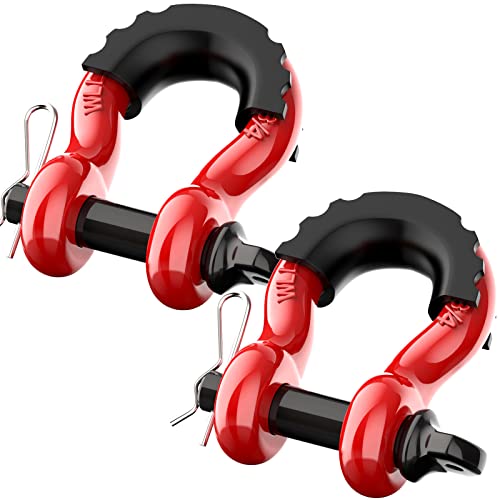
D Ring Shackles 3/4" Heavy Duty 4.75 Ton Screw Pin Anchor Shackles Universal Fit for Off-Road Bumper and Vehicle Recovery Rigging Point Tow Shackle Red Color Clevis Shackle-2Pk
Best for: General recovery and tow point use
This is a sensible choice for owners who want a straightforward, correctly rated 3/4-inch shackle for a bumper recovery point, a tow hitch or a winch line, and who value a clear rated capacity on the listing.
Key specs
- 3/4-inch body diameter
- 4.75 ton rated capacity (per listing name)
- Screw pin anchor design
- Sold as a 2-pack
Pros
- Rated capacity is stated directly in the product name
- Screw pin anchor style is common for recovery rigging
- Sold in pairs, which suits front and rear recovery points
Cons
- Screw pins need to be fully seated and checked before each use
- Rated capacity is lower than heavier forged options in the list
Bottom line: A good first pick for owners who want a correctly rated, straightforward shackle for typical trail recovery.
View on AmazonALL-TOP D Ring Shackle (2 Pack) 3/4″ Fully Forged
ALL-TOP D Ring Shackle (2 Pack) 3/4" Fully Forged with 7/8 Pin, 79500Lbs Break Strength & 9Ton Work Load, Impact Resistant by Extreme E-Coat
Best for: Higher-load recovery setups
This suits owners running heavier vehicles or building a recovery kit around a winch with a larger working load, who want a fully forged body and a higher listed work load.
Key specs
- 3/4-inch fully forged body
- 7/8-inch pin, per listing name
- 79,500 lb break strength and 9 ton work load, as listed
- Extreme E-coat finish listed for impact resistance
Pros
- Fully forged body is generally preferred over welded or cast designs
- Higher listed work load than the other two options
- E-coat finish is listed for corrosion and impact resistance
Cons
- Larger, heavier build can be more than a light rig needs
- Confirm that the pin and body suit your mounting point before buying
Bottom line: Best for owners who want the highest listed work load among these three and plan to use the shackles with heavier recovery loads.
View on AmazonOhuhu D Ring Shackles 3/4″, Heavy Duty Steel Shackles 2 Pack
Ohuhu D Ring Shackles 3/4", Heavy Duty Steel Shackles 2 Pack | 7/8" Pin for Universal Fit, 20 Ton (44,000 lbs) Maximum Break Strength, 4.75 Ton (9,500 Lbs) Capacity Working Load Limited
Best for: Budget-minded buyers who want a 2-pack
This is a practical option for buyers who want a matched pair at a budget-friendly level and a clearly stated working load limit for everyday trail use.
Key specs
- 3/4-inch body
- 7/8-inch pin, per listing name
- 4.75 ton (9,500 lb) working load limit, as listed
- 20 ton (44,000 lb) maximum break strength, as listed
Pros
- Clearly stated working load and break strength
- Sold as a pair, convenient for paired mounting points
- Universal fit language suits many common recovery points
Cons
- Working load is lower than the higher-capacity option in this list
- Owners should verify finish durability if the shackles see frequent saltwater or mud exposure
Bottom line: A solid pick for buyers who want a clearly rated pair without stepping up to a heavier-duty model.
View on AmazonBuying Guide
Working load limit versus break strength
The working load limit (WLL) is the maximum load the shackle should carry in normal use. Break strength is the load at which it is expected to fail. Dynamic recovery loads, such as a vehicle snatching or a winch line under sudden tension, can exceed static weight. Choose a shackle whose WLL comfortably exceeds your heaviest realistic load, and treat break strength as a safety margin, not a usable rating.
Good picks for this: ALL-TOP D Ring Shackle (2 Pack), Ohuhu D Ring Shackles
Shackle size and pin diameter
Match the body and pin to the eye of your recovery strap, chain or hook, and to the mounting hole on your vehicle. A 3/4-inch body is a common size for light-to-medium recovery. Confirm the pin diameter (7/8-inch in two of these listings) fits your mounting point without forcing it. For a full sizing breakdown, see our D-Ring Shackle Size Chart: Rated Capacities and How to Pick the Right Size.
Good picks for this: D Ring Shackles 3/4″ Heavy Duty, Ohuhu D Ring Shackles 3/4″
Locking style: screw pin versus other designs
A screw pin shackle locks by threading the pin through the body, so it stays closed under vibration. Other designs use clips or cotter pins. Screw pins are widely used in recovery rigging, but they must be fully seated and inspected for thread wear before each use. Our D Ring Shackle Lock Guide: How to Choose and Secure Yours Safely covers locking mechanisms in more detail.
Good picks for this: D Ring Shackles 3/4″ Heavy Duty, ALL-TOP D Ring Shackle
Material and forging
Fully forged steel shackles are generally preferred for recovery because forging aligns the grain structure and avoids the weak points of welded assemblies. Check whether the listing states forged construction. Heat-treated alloy steel is common in higher-rated models. Avoid shackles of unknown origin with no published ratings.
Good picks for this: ALL-TOP D Ring Shackle (2 Pack), D Ring Shackles 3/4″ Heavy Duty
Finish and corrosion resistance
Coatings such as e-coat, galvanizing or powder coating slow rust. A color finish, like the red option in one of these listings, also helps you spot a shackle in the mud. If you drive near salt water or in wet climates, prioritize a finish that is rated for corrosion and inspect the shackles regularly for rust, pitting or flaking.
Good picks for this: ALL-TOP D Ring Shackle (2 Pack), Ohuhu D Ring Shackles 3/4″
Use case and load matching
Think about your heaviest realistic recovery. A light crossover on a trail needs less capacity than pulling a stuck full-size truck with a winch. Count the shackles, the strap rating and the mounting point as one system. The weakest component sets the real limit. Our Top 4 Hitch Mounted D-Ring Shackle Options for Off-Road Recovery article looks at hitch-based setups.
Good picks for this: ALL-TOP D Ring Shackle (2 Pack), D Ring Shackles 3/4″ Heavy Duty
Care, inspection and storage
Inspect shackles before every trip. Look for cracks, bent bodies, stretched or deformed bows, worn threads and rust. Replace any shackle that shows damage. Keep screw pins clean and lightly lubricated, and store shackles dry. Never weld, heat or modify a shackle, because that can destroy its rated strength.
Good picks for this: Ohuhu D Ring Shackles 3/4″, D Ring Shackles 3/4″ Heavy Duty
FAQ
What does “locking” mean on a D ring shackle?
Locking usually means the pin is held in place so it cannot back out under vibration or load. Screw pin shackles achieve this by threading the pin fully through the body and tightening it. Always confirm that the pin is seated and secure before attaching a load.
Is a higher working load limit always better?
A higher WLL gives more margin, but the shackle must still match your mounting point, strap and vehicle. An oversized shackle can be heavier and harder to fit, and it does not fix a weak mounting point or a damaged strap.
What is the difference between WLL and break strength?
WLL is the safe maximum load for normal use. Break strength is the load at which failure is expected. Plan around the WLL and treat break strength as a safety reserve, not a working rating.
How often should I replace a recovery shackle?
There is no universal schedule. Replace any shackle that shows cracks, deformation, worn threads, heavy corrosion or any sign it has been overloaded. Owners who use shackles often in harsh conditions inspect them more frequently.
Can I use a D ring shackle on a tow hitch?
Some owners use shackles on hitch-mounted recovery points, but the hitch receiver and mounting hardware must be rated for the load. Check the vehicle manufacturer’s guidance and the hitch manufacturer’s rating before connecting a recovery load.
Should I lubricate a screw pin shackle?
Light lubrication on the threads helps prevent galling and corrosion. Use a lubricant suited to outdoor use and wipe off excess so grit does not collect in the threads.
Do I need a shackle rated for winching?
Yes. Choose a shackle whose rated capacity is appropriate for your winch’s rated pull and for the mounting point. Match all components as a system, and consult your winch and vehicle manufacturer for specific guidance.
Conclusion
For most owners, the D Ring Shackles 3/4″ Heavy Duty 4.75 Ton Screw Pin Anchor Shackles make a clear first choice because the rated capacity is stated in the name and the screw pin design suits general recovery. Buyers who plan heavier loads should look at the ALL-TOP D Ring Shackle (2 Pack), which lists the highest work load of the three. The Ohuhu D Ring Shackles 3/4″ suit budget-minded buyers who want a clearly rated pair. In every case, confirm the working load limit, match the pin to your mounting point, and inspect the shackles before each use. For more options, browse our Locking D Ring Shackle Compared: 3 Best Picks for Off-Road Recovery (2026) comparison.
Sources
- Workplace rigging and load-handling safety guidance, including principles for rated hardware (osha.gov)
- Standards and engineering principles for lifting and rigging hardware
- Recovery and safe vehicle operation guidance from a public land agency (nps.gov)
About Graham Fisher
Graham Fisher is part of our editorial team and reviews and edits our off-road vehicle upgrades guides, checking product details against manufacturer specifications and owner feedback.
About the author
Graham Fisher writes reviews and buying guides for Offroad Lockers.